
Juren Home Steel Door Workshop: Combining Strength and Finesse, Forging a Steel Defense Line of Safety and Aesthetics
2026-06-15
Juren Home Steel Door Workshop: Combining Strength and Finesse, Forging a Steel Defense Line of Safety and Aesthetics
Walking into the steel door production workshop of Juren Home, the first thing you feel is a sense of toughness and strength distinctly different from the wooden door workshop. There is no warmth of wood here; instead, there is the coldness of metal and the roar of machinery. In this spacious, bright, and rigorously laid-out modern industrial plant, every sturdy and aesthetically pleasing steel door undergoes a magnificent transformation from steel coil to finished product.
1. Raw Material Storage Area: The Steel Foundation, Accumulating Strength
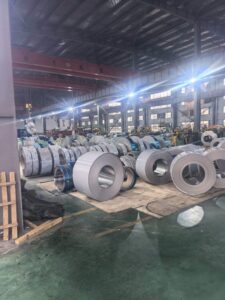
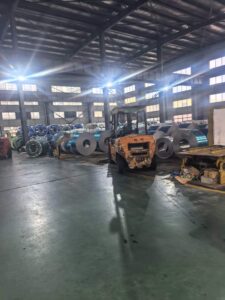
In one corner of the workshop lies the vast and orderly raw material storage area. On the floor, rows of huge metal coils (steel coils) are neatly laid flat or stacked, shimmering with a silvery-gray metallic luster under the lights. These steel plates, which have undergone precision rolling and anti-corrosion treatment, are the starting point of the entire workshop’s production. They are uniform in shape and clearly labeled, waiting for forklifts to transport them to the production line, providing a solid “skeleton” for manufacturing high-strength, durable door bodies. This large-scale, standardized raw material reserve showcases the company’s strong production capacity.
2. Core Processing Area: Repeated Forging, Precise Shaping
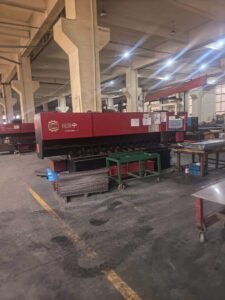
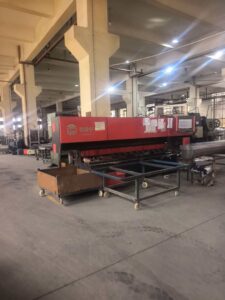
The core area of the workshop is the heavy ground for steel processing. It is equipped with large CNC punching machines, bending machines, and other heavy-duty mechanical equipment.
-
Precision Stamping and Cutting: Huge steel plates are fed into the automated production line. Through laser cutting or stamping dies, they are precisely shaped to form the door leaf contours, lock points, hinge holes, and various decorative lines. The machines operate with precision and efficiency, leaving no room for error, ensuring that every door panel’s dimensions strictly meet the design requirements.
-
Bending and Forming: At the bending machine, the steel plate is bent into 90-degree or more complex three-dimensional structures under the precise control of robotic arms, forming the skeleton of the door leaf. Workers skillfully operate the control console, monitoring the angle and force of each bend to ensure the door structure is flat and firm.
-
Welding and Grinding: Although the level of automation is high, experienced workers still need to perform fine manual welding and grinding at certain stages to eliminate weld spots and create a smooth transition on the door surface, preparing it for the subsequent powder coating process.
3. Surface Treatment and Coating Area: Transforming Steel into Art, Giving It Soul
The durability of steel doors relies heavily on high-quality surface treatment. In this area, the initially formed door bodies are sent into an automated coating line.
-
Phosphating and Primer: The door body first undergoes chemical treatments such as degreasing and phosphating to form an anti-rust primer layer, ensuring the steel does not rust easily during future use.
-
Electrostatic Powder Coating: Subsequently, the door body enters an electrostatic powder spraying booth, where powder coating is evenly adsorbed onto the surface. Then it enters a high-temperature curing oven, where the powder melts and forms a dense, uniform, and strongly adhesive coating. This coating not only provides a rich choice of colors but also endows the door with excellent scratch resistance and corrosion resistance.
-
Baking and Curing: Under high-temperature baking, the coating is completely cured and fused with the steel. From a cold steel plate to a door surface with full color and delicate texture, this process can truly be called “transforming steel into art.”
4. Assembly and Quality Inspection Area: Perfect Fit, Striving for Excellence
At the other end of the workshop is the final assembly and quality inspection area for the door bodies.
-
Hardware Installation: Workers precisely install locks, hinges, door closers, and other hardware accessories onto the door leaves and frames. The tightening torque of every screw is controlled to ensure smooth opening and closing, stability, and durability.
-
Perfect Fit Adjustment: Assembled doors undergo repeated opening and closing tests to check whether the gap between the door leaf and frame is even, whether the closure is tight, and whether the lock operates smoothly.
-
Strict Quality Inspection: Quality inspectors conduct a comprehensive inspection of every door, from surface flatness and coating uniformity to structural stability and hardware flexibility. Through layer-by-layer checks, they ensure that every door leaving the factory meets the “zero defect” standard.
5. Finished Product Storage and Logistics Area: Ready to Ship, Serving Thousands of Homes
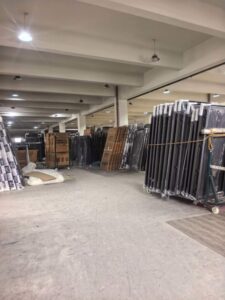
At the outermost part of the workshop is the finished product storage area. Fully processed and packaged steel doors are neatly stacked against the wall, some already covered with protective film, awaiting final packing and shipping. The spacious aisles and reasonable area division facilitate the passage of forklifts and logistics vehicles, ensuring that products can be delivered to customers quickly and safely.
Conclusion
The steel door workshop of Juren Home is a modern manufacturing site full of strength and precision. From heavy steel coils to refined finished products, every step embodies advanced technology, strict management, and the wisdom of craftsmen. Here, they are not just producing doors; they are forging barriers of safety and carriers of aesthetics. By continuously introducing advanced equipment, optimizing process flows, and strengthening quality control, Juren Home is providing safe, reliable, and aesthetically pleasing home protection solutions for thousands of households with its solid steel body.