

Juren Home Bathroom Sliding Door Production Workshop: Precision Craftsmanship, Customizing a Better Life
2026-06-15
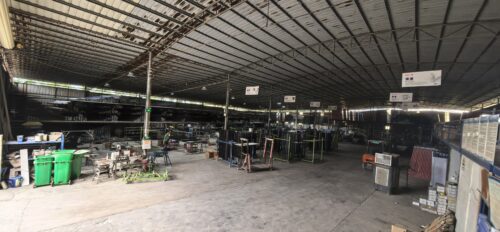
Juren Home Bathroom Sliding Door Production Workshop: Precision Craftsmanship, Customizing a Better Life
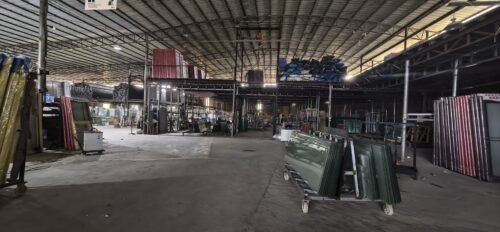
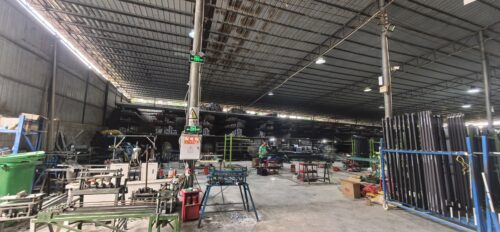
Walking into the bathroom sliding door production workshop of Juren Home, a wave of modern industrial atmosphere greets you. There is no clutter here; instead, there are orderly assembly lines and clearly divided work areas. As a production base specializing in custom high-end home doors and windows, this workshop carries the important mission of transforming design drawings into practical and aesthetically pleasing bathroom space solutions.
1. Raw Material Storage Area: Carefully Selected Materials, Laying a Durable Foundation
On one side of the workshop, neatly arranged shelves and stacking areas come into view. Here are stored the core materials for producing sliding doors: high-strength aluminum alloy profiles, high-quality tempered glass, and various hardware accessories.
-
Profile Area: Aluminum alloy profiles of different specifications and colors are hung vertically or stacked horizontally, with smooth surfaces and uniform oxide layers. From minimalist narrow frames to sturdy wide frames, the abundant profile inventory meets the market’s demand for diverse styles.
-
Glass Area: Bundles of raw glass sheets or semi-finished glass are neatly arranged on dedicated anti-collision racks. Each piece undergoes strict selection to ensure light transmittance and edge flatness, laying the foundation for creating transparent and safe bathroom spaces.
2. Profile Processing Area: Precision Down to Millimeters, Showcasing Exquisite Craftsmanship
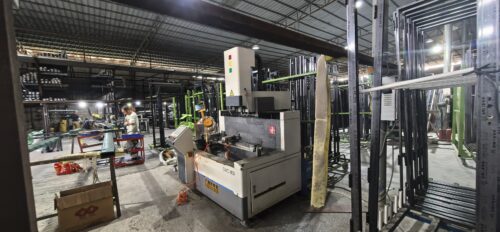
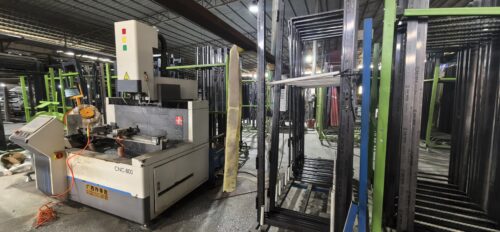
The core area of the workshop is the profile processing zone, equipped with multiple high-precision CNC machines (such as CNC machining centers and double-head cutting saws).
-
Precision Cutting: Workers feed the profiles into the cutting machines. With crisp cutting sounds, the profiles are cut precisely. Whether at right angles or 45-degree miter joints, the equipment controls accuracy down to millimeters or even microns, ensuring seamless dimensions for door frames and door leaves.
-
Drilling and Tapping: On automated drilling equipment, robotic arms position accurately to reserve holes for rollers, hinges, and handles. This automated processing method not only improves efficiency but also eliminates errors from manual operations, ensuring the precision of hardware installation.
-
Surface Treatment Transition: Processed profiles move to the next stage, where workers carefully check whether the cut edges are smooth and free of burrs, performing necessary chamfering to ensure aesthetics and safety during assembly.
3. Assembly and Adjustment Area: Meticulous Assembly, Pursuing Smooth Operation
In the assembly area, semi-finished door frames and door leaves begin to “merge.” Workers follow strict operating procedures to install roller systems, tracks, weatherstripping, and other components.
-
Fine Assembly: Skilled workers use screwdrivers and pneumatic tools to tighten each component. The tightness of every screw is controlled to ensure structural stability while preventing profile deformation caused by over-tightening.
-
Smoothness Testing: After assembly, sliding doors do not immediately proceed to the next stage. Instead, they undergo repeated push-and-pull tests. Workers check whether the door leaves slide smoothly, quietly, and without any jamming. Only doors that pass the “smoothness test” can move to the next process.
4. Finished Product Storage and Quality Inspection Area: Layer-by-Layer Checks, Upholding Quality Commitments
At the end of the workshop are the finished product storage area and a strict quality inspection zone.
-
Appearance Inspection: Quality inspectors examine each finished door with meticulous attention. Everything is checked, from scratches and color differences on the profile surface to the cleanliness and bubbles in the glass, as well as brand markings on hardware.
-
Functional Retesting: In addition to static appearance inspections, sample doors undergo cycle testing to ensure they maintain excellent performance and a long service life under prolonged use.
-
Packaging and Warehousing: Products that pass inspection are covered with protective film, fitted with anti-collision corner guards, and packed into customized cartons. The neatly stacked finished products await shipment to customers nationwide, decorating bathroom spaces in thousands of homes.
5. Site Management and Corporate Culture: Standardized and Orderly, People-Oriented
What impresses most about the entire workshop is not just the advanced equipment but its standardized site management.
-
5S Site Management: The floors are clean, aisles are clear, material labels are distinct, and tools are properly returned. This clean environment not only improves work efficiency but also ensures operational safety for workers.
-
Safety and Environmental Protection: The workshop is equipped with comprehensive dust removal and ventilation systems, ensuring workers operate in a good environment. Safety warning signs and protective equipment seen throughout reflect Juren Home’s emphasis on employee safety.
-
Team Collaboration: From profile processing to finished product assembly, every link is closely connected. Workers cooperate seamlessly, demonstrating a well-trained and highly skilled industrial workforce.
Conclusion
The bathroom sliding door production workshop of Juren Home is a modern manufacturing base that integrates technology, craftsmanship, and ingenuity. Here, every sliding door is not merely an industrial product but a practice of Juren Home’s philosophy of “building quality homes.” Through rigorous material selection, precision processing, meticulous assembly, and strict quality inspection, Juren Home is committed to providing every consumer with safe, beautiful, and durable bathroom door and window solutions, making every slide a pleasure.